
WHEN SILICON MEETS THE SACRED
There was a time when sermon preparation required little more than a Bible, a notebook, and a pen that always seemed to run out of ink just as the good ideas arrived. It was slow, occasionally frustrating, and rarely efficient—but it was deeply human, shaped by silence, struggle, and the slow work of understanding. Now, we have ChatGPT. A tool that does not sleep, does not doubt, and certainly does not forget its references. It produces outlines with unsettling speed and clarity, like a seminarian who somehow skipped the years of confusion and went straight to coherence.
But the real question is not whether you can use it—because clearly, you can. The real question is whether you can use it without gradually outsourcing the very thing that makes your preaching yours: your voice, your conviction, your lived encounter with the text.
THE FIRST RULE: THE HOLY SPIRIT IS NOT AN ALGORITHM
Before the screen lights up, something else must be awakened. The quiet flame of prayer, the deliberate pause that makes room for something deeper than productivity, a presence that does not rush, does not automate, and does not perform on command. Because no matter how advanced AI becomes, it cannot convict a heart, comfort a wounded soul, or call someone into transformation. It cannot wrestle with truth or be reshaped by it. It processes language, but it does not experience meaning.
So, begin where preachers have always begun, even when it feels inefficient. Not with prompts, but with presence. Not with output, but with openness. Because what you bring into the pulpit must first pass through you.

START WHERE PREACHERS HAVE ALWAYS STARTED
Sit with the text long enough that it begins to unsettle you a little. Let it interrupt your assumptions, challenge your preferences, and refuse to be neatly packaged too quickly. Scripture was never meant to be skimmed into submission. Take notes the slow way, the kind that requires you to linger and think rather than collect and move on. Write things down that don’t fully make sense yet, because often the most meaningful insights arrive disguised as questions.
Only after the Scripture has had its way with you—after it has pressed, shaped, and perhaps even corrected, should you invite anything else, including AI, into the process. Otherwise, you risk building a sermon on something you haven’t fully understood.
CHATGPT IS A GOOD ASSISTANT (BUT A TERRIBLE PASTOR)
There is no denying that ChatGPT can be remarkably helpful when used well. It can sketch outlines, surface historical context, and offer phrasing that feels clean, structured, and surprisingly articulate. It can even make you sound like you had more time than you actually did, which on a busy week can feel like a minor miracle. It organizes thoughts quickly, fills in gaps, and reduces the friction of starting from nothing.
But it has read widely without ever believing deeply. It can arrange ideas, but it cannot carry conviction. It may help you speak clearly, but it cannot help you speak truthfully—that part still rests squarely on you.
BORROW IDEAS, NOT IDENTITY
There is a subtle but significant difference between being inspired and becoming dependent, and AI has a way of blurring that line if you are not paying attention. A generated outline can feel complete enough to make you stop thinking too soon. But your congregation does not gather each week to hear what a machine can assemble about a passage. They come to hear what God has done in you through that passage—how it has challenged you, shaped you, perhaps even undone you.
So, take what is useful, then dismantle it without hesitation. Rebuild it in your own voice, with your own emphasis, shaped by your own wrestling. Because clarity without authenticity may impress, but it rarely transforms.
ILLUSTRATIONS: DON’T PREACH SOMEONE ELSE’S STORY
AI has a particular talent for producing neat, well-structured illustrations that land exactly where they should. They are tidy, efficient, and often just relatable enough to feel usable. But real life is rarely that polished, and your people know it. They recognize the difference between something that has been lived through and something that has merely been written well.
So, take those illustrations and reshape them until they feel real, or replace them entirely with stories that carry your own history and context. Because authenticity may be messier, but it resonates in ways perfection never quite can.
TRUST, BUT VERIFY (THEN VERIFY AGAIN)
ChatGPT has a confident tone, and that confidence can be persuasive. It presents information smoothly, often without hesitation, which makes it easy to assume accuracy where there may be none. It may misquote Scripture, blend historical details incorrectly, or present theological interpretations that sound reasonable but lack depth or grounding. And if you are not careful, those errors can quietly make their way into your sermon.
So, verify everything with care. Check your references, confirm your sources, and test every claim against reliable material. Because once spoken from the pulpit, your words carry weight—and that weight demands responsibility.
THE QUIET TEMPTATION OF CONVENIENCE
The real danger of using AI is not dramatic or obvious. It does not announce itself loudly; it slips in quietly, dressed as efficiency, sounding suspiciously like wisdom. It suggests that saving time is always good, that cutting corners is harmless, that getting to “good enough” quickly is better than taking longer to do it well. And on a busy schedule, that logic can feel very convincing.
But over time, convenience can begin to erode depth. And sermons prepared too quickly may lack the kind of substance that only comes from patience, reflection, and honest engagement with the text.
ETHICAL USE: A SIMPLE RULE OF THUMB
If your sermon still sounds like you—your phrasing, your rhythm, your way of seeing things—then you are likely using AI in a healthy way. It means the tool is assisting, not replacing, your work. If, however, the sermon feels polished but strangely distant, as though it could have been written by anyone, then something has shifted. The structure may be strong, but the substance may feel thin.
Preaching without depth is like lighting a fire that produces light but no warmth. It may look convincing at first glance, but it does not sustain or transform those gathered around it.
WHY THIS MATTERS MORE THAN YOU THINK
Because preaching is not simply about delivering information in an organized way. It is about forming people, shaping understanding, and faithfully handling something that carries eternal weight. It requires more than clarity or eloquence. It requires care, attentiveness, and a kind of honesty that comes from having truly engaged in what you are about to say.
And while tools may change and methods may evolve, the responsibility does not. The calling remains deeply human, requiring presence, integrity, and intention.
A BETTER WAY FORWARD
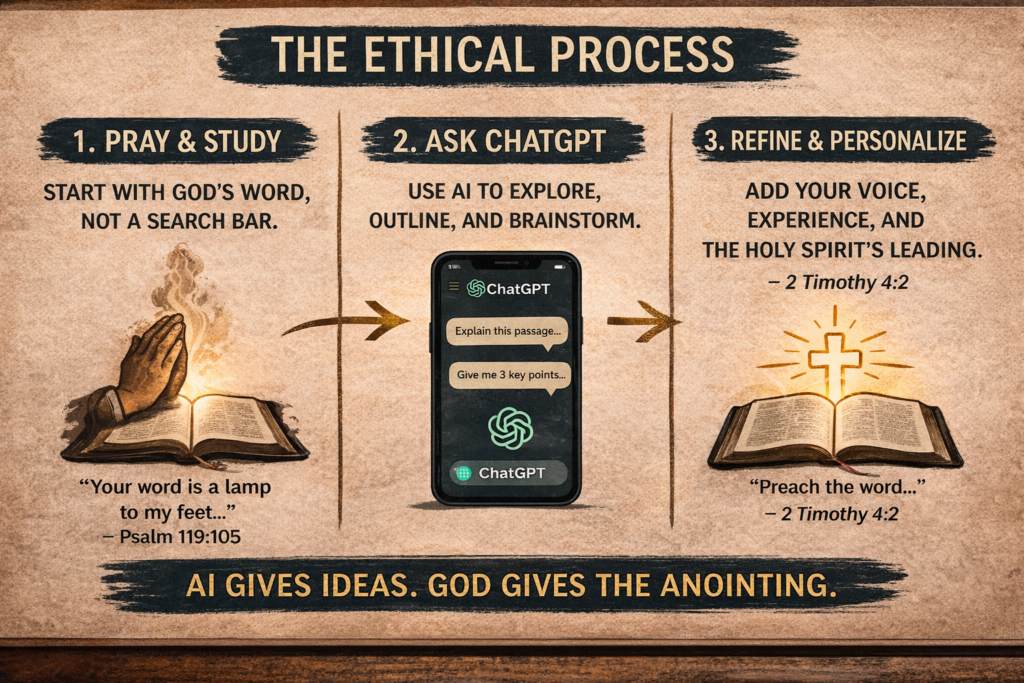
Use ChatGPT as you would a capable and thoughtful assistant—valuable, efficient, and helpful within its proper place. Let it support your thinking without taking over your responsibility. Let it suggest ideas, but do not let it define your message. Let it help clarify your structure, but never determine your substance. Keep it in its proper role, and it can genuinely serve your work.
Always return to the source that does not depend on technology, the quiet, steady presence that has guided faithful preaching long before algorithms ever entered the conversation.
FINAL WORD (BEFORE YOU OPEN THAT TAB)
Technology is not the enemy, nor is it inherently dangerous. It is simply powerful, and anything powerful requires wisdom in how it is used. So, prepare your sermons with Scripture open before you, your heart attentive within you, and your tools positioned carefully around you. Let each play its role, but do not confuse them.
And if ChatGPT helps along the way, let it remain what it is meant to be—a tool in your hands, not a voice in your place, and certainly not the one standing in the pulpit.
About the Author