
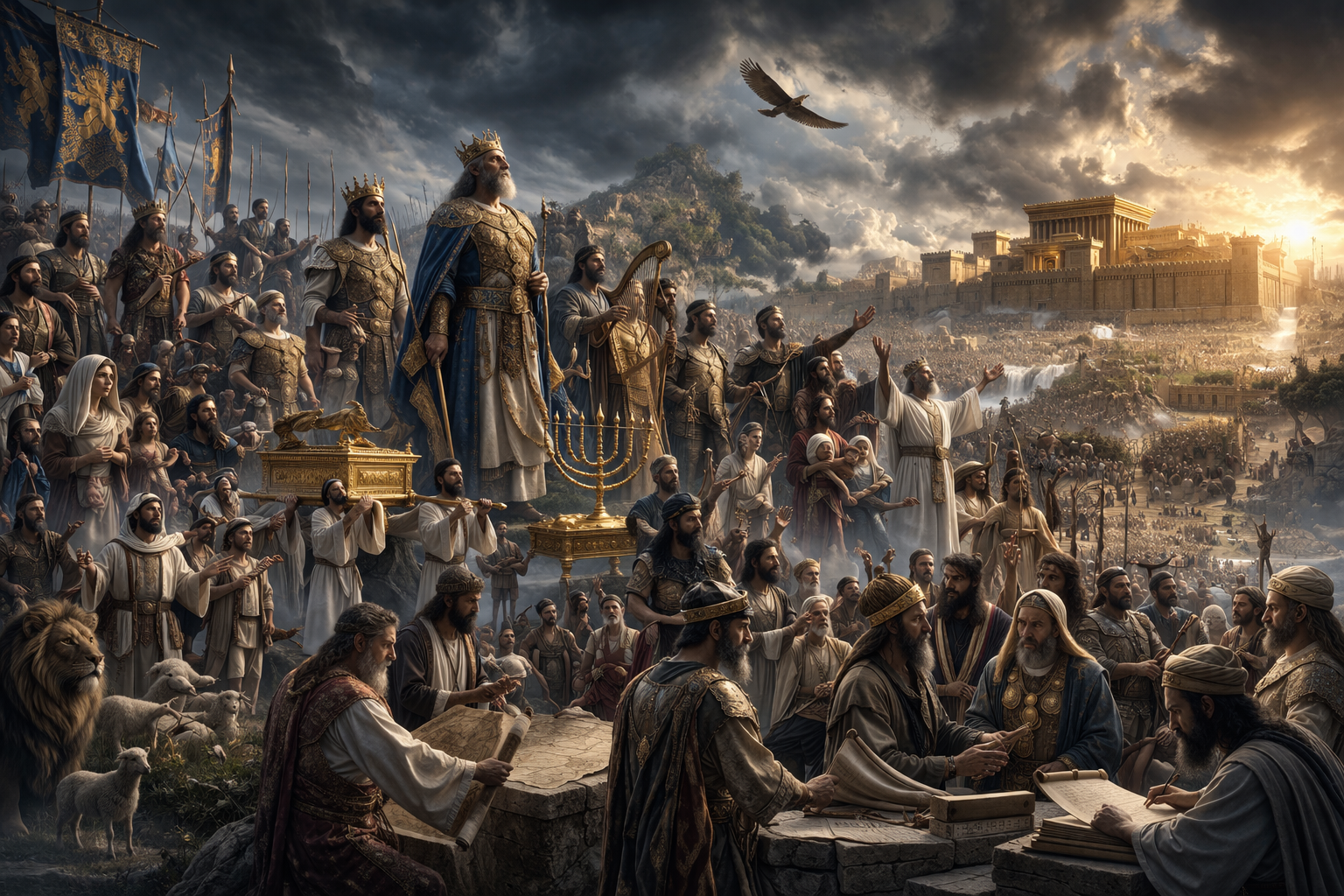
TEXT: 1 Chronicles 9:1 – So all Israel were reckoned by genealogies; and behold, they were written in the book of the kings of Israel and Judah, who were carried away to Babylon for their transgression. (KJV)
This is the complete family tree for all Israel, recorded in the Royal Annals of the Kings of Israel and Judah at the time they were exiled to Babylon because of their unbelieving and disobedient lives. (The Message Bible)
INTRODUCTION: WHY THE BOOK OF 1ST CHRONICLES?
At first glance, the opening chapters of 1 Chronicles feel like a family reunion guest list. Name after name, line after line, from Adam to Abraham, to Jesse and to Jeconiah. To the modern reader, it might seem like a long roll call with no spotlight. But heaven doesn’t waste ink. There are no throwaway lists. These names breathe. They weep. They worship. Ezra the Chronicler dipped his quill into the inkpot and draws the arteries and veins of redemptive history, pulsing with covenant blood, bearing witness that God’s salvation has always been a matter of generations.
Each syllable tells a story: some of scandal, some of strength; some of exiles, others of exodus. Some names rise with glory; others whisper shame. But all are remembered. Because to God, lineage is more than biology—it’s theology. Family isn’t just who you come from; it’s what you carry. And this lineage carries promise.
And so, Ezra writes. Not to impress, but to remind. Not to glorify man, but to showcase the unwavering fidelity of God—a God who keeps names, who keeps promises, who keeps watch over His word to perform it. A God who does not forget the faithful. A God who remembers the fatherless, who counts the wanderers, who numbers even the hairs on our heads. Ezra writes because these names are echoes of God’s mercy in motion. Every generation recorded, every life remembered, is proof that grace is not just random – it’s generational. Passed down. Passed on. A holy contagion of covenant love.
I. FROM ADAM TO ABRAHAM: THE ROOTS OF OUR REDEMPTION
Ezra begins with Adam to remind us: we all come from the same dust. This is no tribal boasting. Every nation, every tribe, every color and dialect and dialectic, bears the image of Adam. And every soul—no matter how polished or broken—aches for the same remedy: the promise given to Abraham. We all hang on to that promise.
To Abraham, God swore three things: land, seed, and blessing. But this was never meant to be hoarded. God wasn’t creating a private club but a launching pad. A family that would bring birth to a nation that would bless the world. 1 Chronicles doesn’t linger in story here—it doesn’t need to. It simply named, and every name hums with covenant tension. Abraham is the root. Faith is the trunk. Christ is the fruit.
And here’s where it gets wild: if you are in Christ, you’re part of this tree. Grafted in by grace. Your spiritual DNA has been rewired to match the bloodline of the Messiah. You may not see your name in the Chronicles, but heaven has scribbled it in the Lamb’s Book with ink that cannot fade. You’re not just a believer, you’re an inheritor. A child of the promise. A descendant by adoption, not of physical blood but of by the blood of Christ. Your inclusion into the promise is by virtue of the New Birth.
You are part of the story. You carry covenant cargo in your soul. You walk in a line of faith that stretches back to Eden and stretches forward to eternity. And that means your life is not small. It is storied by God Himself.
II. FROM ABRAHAM TO DAVID: KINGS AND COVENANTS
The Chronicler speeds through centuries like a man late for a coronation—until he slows, not at Saul, but at David. David wasn’t flawless. He stumbled in valleys of lust and pride. But he was chosen. Chosen not because of his perfection, but because of his pursuit. His line, as recorded in 1 Chronicles 3, is not just royal blood; it is red with promise. Each descendant carries the scent of Bethlehem and the shadow of Calvary.
The Chronicler nods briefly at Saul, (8:33) Israel’s first king. A man crowned by the people, but not anointed for eternity. Saul’s lineage is mentioned like a candle in the wind—visible, but flickering. Then gone. Meanwhile, David’s line burns on like a torch in the night, leading us through wilderness and exile, through manger and ministry, all the way to a cross that would crown the truest King.
To the exiles returning from Babylon, David’s name wasn’t just history, it was hope. It was melody after a lifetime of silence. A promise humming beneath the rubble: God has not forgotten. The temple may be broken. The walls may be torn. The throne may be empty. But the covenant? Oh, the covenant is alive and well.
The Chronicler knew what he was doing. He was placing David like a diamond in the text—because David’s lineage would sparkle through the dirt of exile and into the dawn of a Messiah. The crown may have been displaced, but it was not discarded. The promise still pulsed through the generations, waiting for the sound of a baby’s cry in a stable.
And for us? David’s story reminds us that God’s promises outlive our failures, outlast our exiles, and outshine our darkest nights. When it feels like the promise is on pause, remember that God never misses a generational beat. The scepter still rests in the hands of the Son of David. And His reign has no end.
III. LEVI AND THE TEMPLE: PRIESTLY PROOFS
And then, Levi.
Tucked reverently into chapter 6 is a meticulous catalog of the priestly tribe. While other tribes received land, borders, and inheritance, Levi received something better: God Himself. They were not owners of soil, but carriers of sanctity. Their territory was not geographical but spiritual. The Levites were the stewards of sacred space. The keepers of incense and intercession. The ones who bore the holy weight of ministering before the Most High. They didn’t build cities, they built altars. They didn’t raise armies, they raised praise. They stood between the people and their God with trembling hands and consecrated hearts.
And the Chronicler doesn’t just list them; he validates them. He tracks their line from Levi to Kohath to Amram to Aaron and his sons. Because legitimacy mattered. Lineage was not a vanity project; it was a verification of vocation. After the exile, temple life was being rebuilt from the rubble, and not everyone who wanted to serve was permitted. If you couldn’t trace your name back to Aaron, you couldn’t light the lamp or lift the laver. Worship required witness. Holiness had a history.
Why? Because in the kingdom of God, access isn’t earned—it’s entrusted. And in that ancient system, bloodlines bore the trust. But then came Jesus. The better Aaron. The eternal Intercessor. With no earthly pedigree to the Levitical priesthood, yet clothed in the full authority of heaven’s calling. He tore the veil and rewrote the registry.
Now we, the Church, are the new Levites. A royal priesthood. Not chosen by blood, but by blood spilled. Not set apart by genealogy, but by grace. We don’t carry censors; we carry crosses. We don’t burn incense; we become it—living sacrifices, holy and pleasing to God. So, when you read Levi’s name in the Chronicles, don’t skim. Stand up. Because that name isn’t just about ancient duty, it’s about your daily calling. To worship. To minister. To intercede. To be the kind of priest who walks into dark rooms carrying light, who turns ordinary spaces into sanctuaries.
IV. WHY THE NAMES? A THEOLOGY OF MEMORY
Nine chapters of names. Why? Because God remembers. He remembers dust and promise. He remembers exile and return. He remembers the ones who wandered and the ones who wept. He remembers the faithful who failed, and the failures who found their way home.
For a people crawling out of Babylon—scarred, scattered, soul-weary—these names were lifelines. Sacred anchors in uncertain seas. They whispered, “You still belong. You’re still part of the plan.” The land may have been scorched, the temple a smoldering ruin, the songs of Zion drowned in foreign rivers—but the covenant? Unburned. Unshaken. Unforgotten. Each name is a stake driven into the soil of history, declaring that God preserves what man forgets.
These names tell more than who begat who. They tell of preservation. Of a divine thread that would not snap. Through war and wandering, through idolatry and judgment, through exile and silence—God kept the line alive.
There is a scarlet thread that runs from Adam to Abraham, from Jesse to David, and from David to Christ. It winds through the wombs of barren women and the bloodlines of broken men. It survived famine and failure, empire and exile. It is the thread of grace, dyed crimson by the covenant love of a God who refuses to let His story die out.
V. A LEGACY IN THE DUST
What do these mean to us?
First: You are known. Not just numbered. Named. You are not a digit in heaven’s database; you are a name on the palm of His hand. You are not a cosmic accident. You are a covenant echo. He doesn’t forget the faithful, and He doesn’t overlook the forgotten. You are seen, counted, and carried.
Second: You are grafted. Through Christ, the wild branches have been brought into the tree of promise. You share the inheritance of saints, not by ancestry but by adoption. You belong to a lineage of faith that cannot be broken by death or time. Your name is part of God’s redemptive mosaic—a living stone in the temple of grace.
Third: You are building a legacy. Every whispered prayer, every act of obedience, every tear shed in worship, every child you bless in Jesus’ name—it all etches your faith into the annals of heaven. You are not just passing through history; you are helping write it. You’re crafting a gospel footnote that future generations may one day trace with grateful hands.
CONCLUSION: A GENEALOGY IN HEAVEN
One day, another genealogy will be read. It won’t be scrolls or census rolls. It will be the Lamb’s Book of Life. And in it, every name will be written—not in fading ink, but in blood that speaks a better word. Names like Rahab. Names like Ruth. Names like yours. Names like mine.
Ezra chronicled generations to remind us: God is faithful across centuries. He doesn’t just rescue us from our past—He roots for us in the future. So, stand tall in the family tree of grace. Lift your eyes to the Author and Finisher of the lineage you now share. You’re not just part of history. You’re part of God’s story.
\ Get the latest news /
